
By the Omozing Credit Team · Updated October 2026 · 8-minute read
हिंदी में: चेक बाउंस अपने आप CIBIL को रिपोर्ट नहीं होता, लेकिन अगर वह चेक या NACH आपकी लोन EMI का था और भुगतान समय पर नहीं हुआ, तो देरी आपकी क्रेडिट रिपोर्ट में दर्ज होती है और स्कोर घट सकता है।
True or false: does a bounced cheque reduce your CIBIL score?
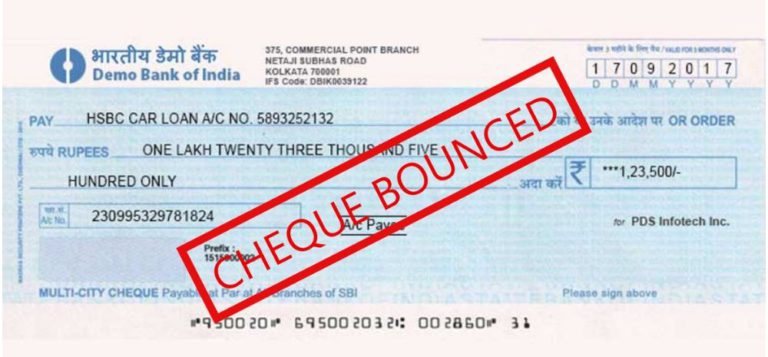
Credit bureaus such as TransUnion CIBIL record your loans and credit cards: how much you owe and whether you pay on time. They do not receive a list of every cheque that bounces from your savings account. So a cheque you gave a landlord or a supplier that bounces does not, by itself, appear on your credit report.
But most bounces that matter to borrowers are not that kind. They are an EMI collected by ECS, NACH or a post-dated cheque, or a card bill paid by auto-debit. When that payment fails, your lender records the EMI as unpaid, and if it is still unpaid when the lender reports to the bureaus, your report shows the account as overdue.
Usually no score impact
A personal cheque to a person or business bounces, and you settle it with them. Not a credit account, so not reported to bureaus. Legal risk still applies (see below).
Can hurt your score
An EMI cheque, ECS or NACH mandate, or card auto-debit bounces and the amount stays unpaid past the lender’s reporting date. Reported as days past due.
What happens after an EMI bounce
Two sets of charges usually follow. Your own bank may charge for the returned cheque or failed mandate, and your lender may add a bounce charge and penal charges as set out in your loan agreement and Key Fact Statement. Check both schedules of charges so you know the actual cost.
How the damage grows the longer it stays unpaid
Days past due and how lenders read them
A general guide to how lenders typically read days past due. Exact score impact depends on your whole report. A loan overdue for more than 90 days can be classified as a non-performing asset under RBI norms.
The key point: the bounce is a one-day event, but days past due keep counting until you pay. A bounce cleared within a day or two often never reaches the bureau as a delay. One left for two months becomes a 60-day entry that lenders will see for years.
The legal side: cheque and mandate dishonour
Separately from your credit score, a bounced cheque can have legal consequences. Under Section 138 of the Negotiable Instruments Act, a cheque returned for insufficient funds, issued to pay a debt, can lead to a criminal complaint. The payee must send you a written notice within 30 days of learning of the bounce, and you then have 15 days to pay. If you don’t, the court can impose imprisonment of up to two years, a fine of up to twice the cheque amount, or both. Failed electronic mandates such as ECS or NACH can attract similar action under Section 25 of the Payment and Settlement Systems Act.
In practice, most lenders contact you and ask you to pay well before any of this. If you receive a notice, take it seriously and respond within the deadline. Our guide to cheque bounce notices explains the process.
A bounced EMI is a cash-flow problem for a day. Ignored, it becomes a credit problem for years.
Bounced? How to recover, step by step
Pay the EMI the same day if you can
Use your lender’s app, payment link or net banking to pay the missed EMI plus any charges. Don’t wait for the next presentation of the mandate.
Confirm in writing
Ask the lender to confirm the EMI is received and the account is current. Keep the receipt.
Fix the cause
Was it a timing gap between salary credit and EMI date? Ask the lender to move the EMI date a few days after payday. If the mandate failed for a technical reason, such as a signature or account mismatch, re-register it. See how e-NACH and e-mandates work.
Keep a buffer
Hold at least one EMI’s worth in the debit account. It is cheaper than any bounce charge.
Check your credit report after the next cycle
If a delay was reported even though you paid in time, raise a CIBIL dispute with your payment proof.
Rebuild with clean months
If a delay was reported, the best repair is a run of on-time payments. More in 9 hacks to improve your CIBIL score fast.
If bounces keep happening
Repeated bounces usually mean too many EMIs for your income, often several small loan-app loans due on different dates. Each one is a chance for a bounce, a charge and a reported delay.
- Several EMIs or app repayments falling in the same week.
- Taking a new loan to pay an old one.
- Paying bounce and late fees most months.
- Avoiding calls from lenders.
If that sounds familiar, consolidating can help. SmartSwitch replaces several short-term loan-app loans with one Omozing loan and a single EMI. The money goes to your own account, you close each app loan within about seven days and share the closure NOCs. As an illustration, ₹75,000 spread across three apps can cost around ₹30,000 a month in fees and interest when rolled over (10% fee per rollover plus 1% a day), against one EMI of about ₹7,750 for 12 months (illustration: 2% a month flat plus a 4% fee). That works out to roughly ₹3.4 lakh kept over a year. Try the calculator with your own numbers.
Juggling EMIs and bounce charges?
Replace several loan-app repayments with one EMI on a date that suits your salary.
Omozing is the digital lending brand of Aparampaar Finance, an RBI-registered NBFC lending to salaried people across India. We consider applicants with a credit score from 600 and take-home pay of ₹40,000 or more, and a credit officer reads your full report, so one past bounce that you cleared quickly is read in context.
Frequently asked questions
Does a bounced cheque reduce my CIBIL score?
Not directly. Bounces are not reported to credit bureaus. But if the bounced cheque or mandate was for a loan EMI or card bill and the amount is still unpaid when the lender reports, your report will show it as overdue, which lowers your score.
Does an ECS or NACH bounce affect CIBIL?
The same logic applies. The failed debit itself isn’t reported, but the unpaid EMI is. Pay it immediately through another channel to avoid or limit a days-past-due entry.
If I pay the bounced EMI within a few days, will it show on my report?
Often not, if you pay before your lender’s reporting date and the lender records the account as current. If a short delay is reported, it has much less impact than a longer one and fades as you add on-time payments.
How long does a late payment stay on my credit report?
Your report shows several years of monthly repayment history, so a reported delay stays visible for years. Its effect on your score reduces over time as you build a record of on-time payments.
Can I go to jail for a cheque bounce?
A cheque issued to repay a debt that bounces for insufficient funds can lead to a criminal complaint under Section 138 of the Negotiable Instruments Act if you don’t pay within 15 days of receiving a legal notice. Paying within that window resolves most cases.
Can I get a loan after a cheque bounce?
Yes, if the bounce was cleared quickly and your report shows no ongoing overdue amounts. Omozing considers salaried applicants with a score from 600, and a credit officer reads the full report rather than rejecting on a single past event.
Omozing is the digital lending brand of Aparampaar Finance Private Limited, an RBI-registered non-deposit-taking NBFC. Loans are subject to credit assessment. This article is general information, not legal advice. See our regulatory disclosures and grievance redressal process.