
By the Omozing Credit Team, which includes IIT and IIM alumni · Updated October 2026 · 9-minute read
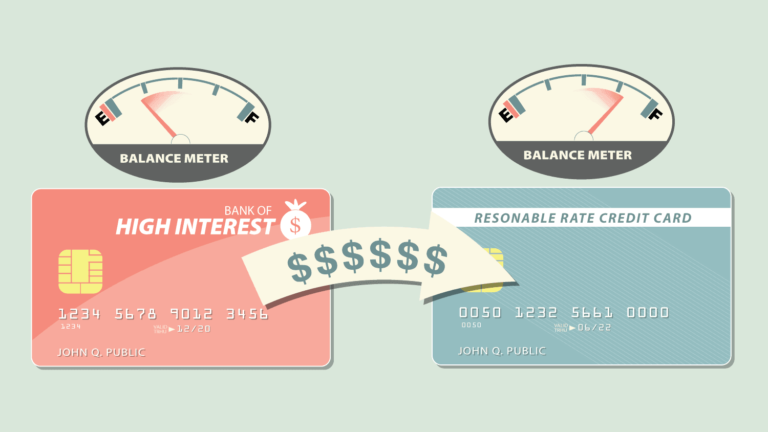
This guide compares the five ways to move card debt, with worked numbers. It does not rank banks or quote their current rates, which change often; instead it shows you what to compare and where to check. For how a card-to-card balance transfer works in detail, see our explainer on credit card balance transfer.
Why moving card debt is worth the effort
Card interest on balances you don’t clear in full is among the most expensive credit in India, and GST is charged on that interest too. Paying a fixed amount each month feels responsible, but much of it can go to interest. Here is what that looks like.
Total cost of clearing ₹2 lakh of card debt (illustrative)
Illustrative assumptions, not offers. Revolving: 3.5% a month plus 18% GST on interest, paying ₹10,000 a month (44 months, ₹2,32,132 interest and GST). Card EMI: 18% a year for 24 months, 1% fee, GST on interest and fee (₹49,130). Personal loan: 14% a year reducing balance for 24 months, EMI ₹9,603, 3% processing fee plus GST (₹37,542). Your card’s MITC and each lender’s Key Fact Statement show actual costs.
Paying roughly the same ₹10,000 a month, the difference is almost two years and close to ₹2 lakh.
The five routes, compared
| Route | How it works | Best when | Watch for |
|---|---|---|---|
| 1. Transfer to another credit card | A new or existing card pays off your old card; you owe the new card, often at a low introductory rate for a few months | Small balance you can clear within the offer period | One-time fee; normal card rates after the offer ends; new card limit may be lower than your debt |
| 2. EMI conversion with your own issuer | Your card’s outstanding is converted into fixed EMIs on the same card | Quick fix, no new lender | Rate, processing fee, GST on interest; the converted amount still blocks your card limit |
| 3. Personal loan to pay off the card | An unsecured loan is credited to your bank account; you pay off the card and repay fixed EMIs | Larger balances, several cards, or 1–3 years to repay | Processing fee; the temptation to reuse the freed-up card |
| 4. Top-up on an existing loan | Your current lender adds money to a loan you already repay | You have a home or personal loan with a good track record | Tenure extension that raises total interest |
| 5. Loan against deposits or assets | Borrow against your own FD, insurance policy or other assets | You have such assets and want the lowest rate | Risk to the asset if you can’t repay |
For route 4, our guide to top-up loans shows how a stretched tenure can quietly add cost. For route 5, see our guide to secured loans against assets.
What about “0% balance transfer”?
Some card-to-card transfers offer a low or zero rate for an introductory period. These can work well, but only with a plan:
- There is usually a fee, charged upfront, plus GST. A “0%” offer is not free.
- The offer period is short. Anything still unpaid afterwards attracts the card’s normal rate.
- Missing a payment can end the offer early, depending on the card’s terms.
- New purchases may be charged differently from the transferred balance. Read the MITC before using the card.
Divide the transferred amount by the number of months in the offer. If you can’t pay that much each month, an EMI-based option is usually safer.
How to choose in four steps
Add up the full debt
List every card, its outstanding, minimum due and rate. Include any card EMIs already running.
Decide your monthly repayment
Pick an amount you can pay every month after essentials. That sets your tenure.
Get the total cost of two or three options
Ask for the APR or full cost in writing: rate, fees, GST, foreclosure charges. Under RBI rules, lenders must give a Key Fact Statement with the APR before you sign a loan.
Close the old debt fully, and freeze the habit
Pay off the card on the day the money arrives, then lower the card limit or keep the card at home. Moving debt only helps if it does not come back.
What happens to your credit score
Can help
- Card utilisation falls sharply once the balance is cleared.
- A fixed EMI paid on time builds a clean repayment record.
- Fewer missed minimum dues across several cards.
Can hurt
- Several loan or card applications in a short span add enquiries.
- Running the card balance up again doubles your debt.
- Closing your oldest card can shorten your credit history; often it is better to keep it with a low limit.
For more on how card balances affect your score, read the perils of maxing out your credit card and our guide to the credit card over-limit fee.
Route 3 with Omozing (our product)
Omozing offers personal loans that salaried people can use to clear card debt: up to ₹25 lakh, unsecured, for 3 to 36 months, with rates starting from 11% a year and a processing fee of 3% to 7% plus GST. The money goes to your own bank account and you pay off your cards directly. You need a take-home salary of ₹40,000 or more a month and two documents: your latest salary slip and a 6-month salary-account bank statement. We consider credit scores from 600, and a credit officer reads your full report, which helps if high card utilisation has dented your score. The exact rate, fees and APR are in the Key Fact Statement before you sign, so you can compare it with your card’s EMI offer line by line.
If your debt is mainly in short-term loan apps rather than cards, SmartSwitch is built for that: it consolidates several app loans into one Omozing loan and one EMI.
See what one EMI would cost instead of your card bills
Check your Omozing personal loan offer and compare the APR with your card’s interest and EMI conversion offer.
Frequently asked questions
What is a credit card balance transfer loan?
It is any credit used to pay off a credit card balance so you repay it at a lower cost and with a fixed end date. It can be another card’s balance transfer offer, an EMI conversion, a personal loan, a top-up or a secured loan.
Can I transfer my credit card balance to a personal loan?
Yes. You take a personal loan, it is credited to your bank account, and you use it to pay off the card in full. You then repay the loan in fixed EMIs, which is often cheaper than revolving card interest.
Is a 0% balance transfer really free?
Usually not. There is often a one-time fee plus GST, the low rate lasts only for an introductory period, and the card’s normal rate applies to anything unpaid after that. Read the card’s MITC first.
Which is better: card EMI conversion or a personal loan?
It depends on the rate, fees and GST in each offer and how long you need. Card EMIs are quick but keep blocking your card limit; a personal loan can clear several cards at once. Compare the total cost in writing.
Does a balance transfer affect my CIBIL score?
Clearing a high card balance lowers utilisation, which tends to help, and on-time EMIs build your record. Multiple applications in a short time and running the card up again can hurt.
Can I get a balance transfer with a low credit score?
Card balance transfer offers usually need a good score. With a lower score, a personal loan from a lender that reads your full report may be an option; Omozing considers salaried applicants with scores from 600.
Omozing is the digital lending brand of Aparampaar Finance Private Limited, an RBI-registered non-deposit-taking NBFC. This article is general information as of October 2026, not financial advice; check each issuer’s MITC and each lender’s Key Fact Statement before acting. See our regulatory disclosures and grievance redressal process.